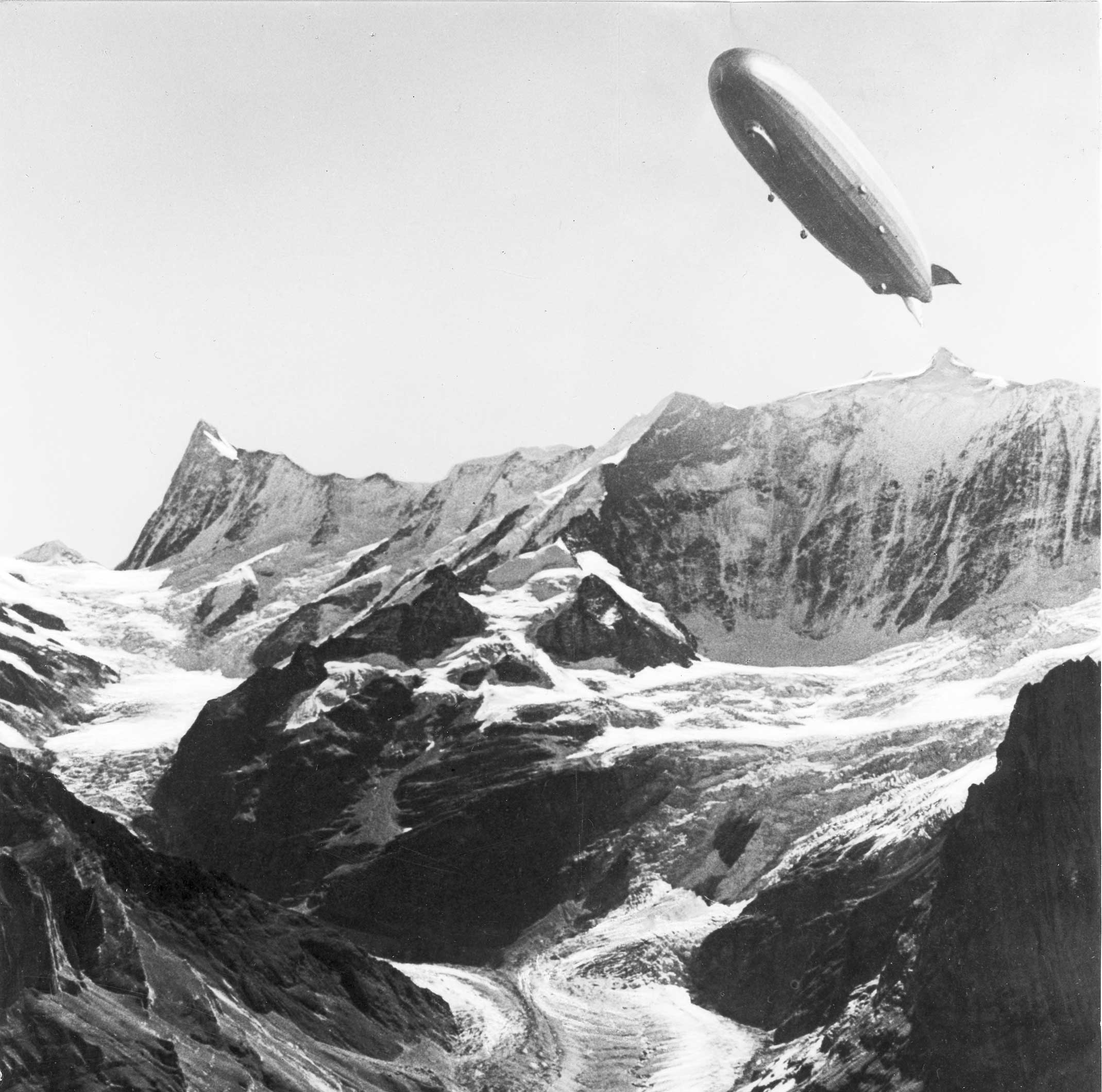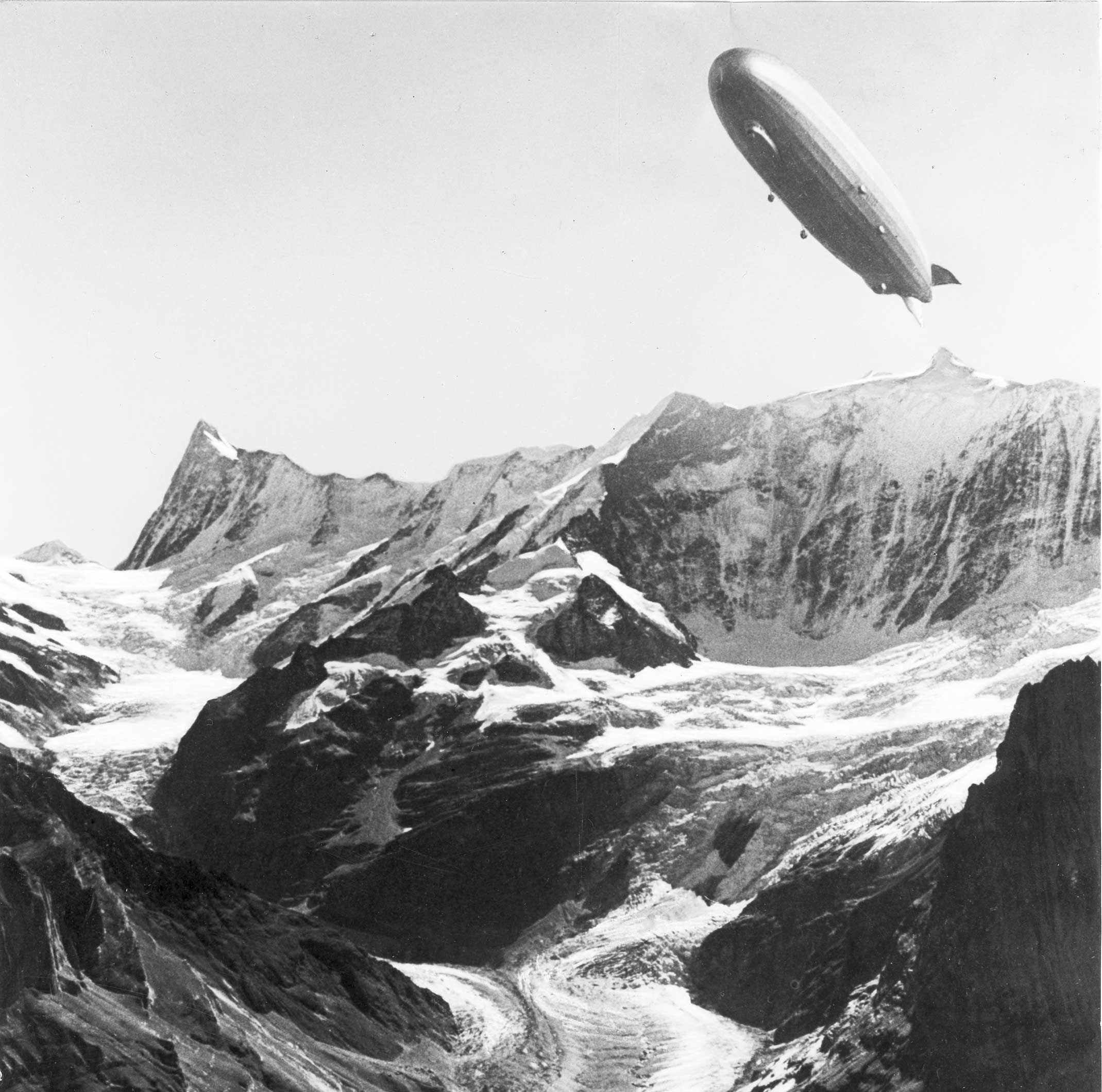

100 years ago on May 11, 1926

In 1911, Roald Amundsen (born 1872, died 1928) became the first person to reach the South Pole. At that time, it was still believed that Robert Peary had conquered the North Pole in 1909. From the outset, there had been doubts about Peary’s claims, and today there is little doubt that he did not reach his destination.

When the airship Norge took off from Ny-Ålesund on Spitsbergen on May 11, 1926, bound for Alaska via the North Pole, the 16-member crew, including Nobile, Amundsen, and Ellsworth, had to assume that the American Richard Byrd had already succeeded in flying over the North Pole in an airplane two days earlier. However, his claim that he and his co-pilot Floyd Bennett had reached and circled the North Pole before landing back on Spitsbergen could never be proven. Therefore, May 12, 1926, when the Norge reached the North Pole after a journey of 16 hours and 40 minutes, is considered the first indisputably confirmed date. The Norge successfully continued its journey and, despite bad weather that made navigation difficult, landed without a ground crew at Teller near Nome, Alaska, almost 70 hours after taking off from Spitsbergen. Immediately after landing, the cover was opened to allow the gas to escape. The ship was dismantled on site.

With a length of 106 meters and a width of 19.5 meters, the airship “Norge” did not reach the dimensions of the German Zeppelin airships. The airship LZ 126 (ZR III), built at the expense of reparations for the USA, was considerably larger and had been in service for two years. The Norge had a volume of 19,000 cubic meters. It was powered by three Maybach engines, each with 180 kW (245 hp), and had a maximum speed of 113 km/h.

2026 Annual General Meeting in Hangelar

This year’s Annual General Meeting will take place on May 30, 2026, at Udet’s Restaurant at Hangelar Airfield (Bonn). On this weekend, the Zeppelin will fly from Hangelar over Cologne and along the southern route over the Siebengebirge mountains. Official invitations will be sent to our members at the end of March.

The winner has been determined

Martin Frick from Altenrhein is the winner of our calendar photo competition for 2026. Three of his photos have been selected for the Zeppelin NT calendar for 2026. Martin Frick can look forward to a flight voucher for a one-hour flight. We look forward to seeing more beautiful photos.

Airship literature

Here is a list of books published by club members related to Zeppelins.

Factual books

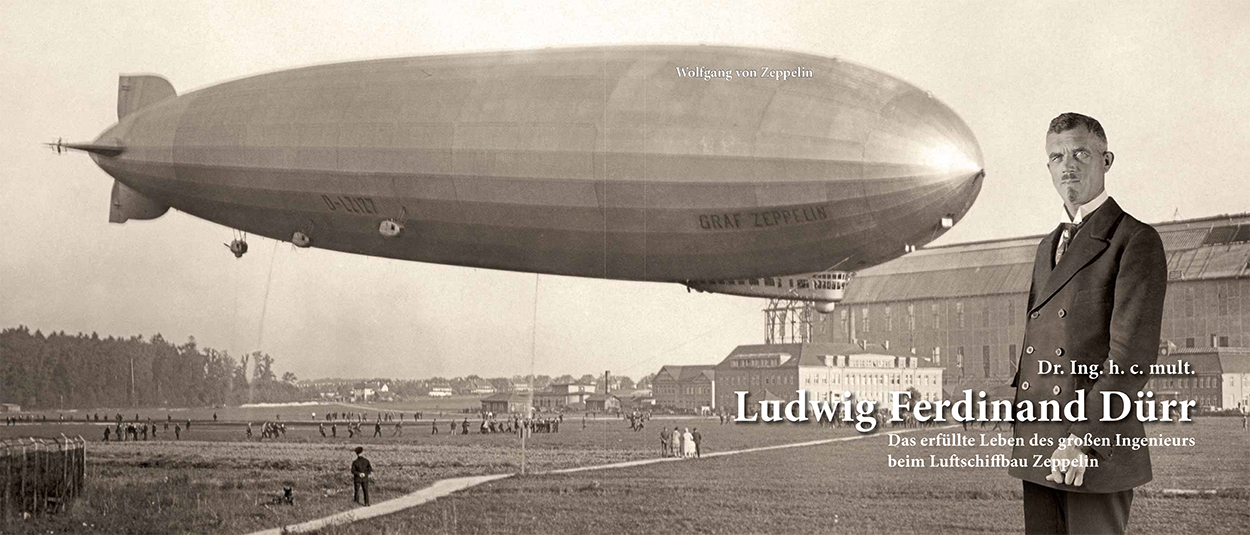
  • (in german) Dr. Ing. h. c. mult. Ludwig Ferdinand Dürr : Das erfüllte Leben des großen Ingenieurs beim Luftschiffbau Zeppelin, Author: Wolfgang von Zeppelin, Initial publication in 2013, ISBN 978-3-9815204-3-9, Obtainable at Zeppelin Museum Friedrichshafen or LTA-Shop.
  • (in german) Der Zeppelin kommt : 100 Jahre Luftschiffe über Dresden, Author Thomas Lohse, Initial publication in 2010, ISBN 978-3-00-028359-8, Obtainable at Author or LTA-Shop.

Novels

  • (in german) Der Wolkenwal : Die Afrikafahrt des L 59 – ein phantastisches Abenteuer, Author: Charles Frölich, Initial publication in 2017, ISBN 9783737527507, Obtainable at Epubli.
  • (in german) Der endlose Tag, Author: Charles Frölich, Initial publication in 2014, ISBN 9783737501644, Obtainable at Epubli.
  • (in german) Herr Käsekuchen : Ein Schritt vor die Tür, Author: Charles Frölich, Initial publication in 2018, ISBN 9783746705644, Obtainable at Epubli.

recommended by club members

Testimonials and memories

  • (in german) Im Zeppelin über Länder und Meere : Erlebnisse und Erinnerungen, Author: Hugo Eckener, republication in 2012, ISBN 978-3-943915-01-3, Obtainable at Zeppelin Museum Friedrichshafen 
  • (in german) Onkel Hugo : Hugo Eckener in Briefen, Selbstzeugnissen und Erinnerungen, Author: Inge Gollbeck-Eckener, republication in 2002, Obtainable at Zeppelin Museum Meersburg

There is a great number of literature on airships and zeppelins. We therefore expand this list by recommendation only to ensure clarity. You have a suggestion? Contact us! If you want to see your own book here, let yourself be infected by the fascination Zeppelin and become a club member!

Zeppelin NT

The development of the Zeppelin NT

technological advances and a rethinking in society created the basis

Since mid 1991 certain news releases appeared from time to time about new activities on airship construction in Friedrichshafen. What was this all about? It was in 1988 when first thoughts were made on whether it would be economically and technically viable to revive airship travel. What had changed to ask this question again?

Another reason is that people seem to enjoy more nostalgic experiences showing in the strong increase of hot air balloon trips as well as traveling with steam trains, steam boats and canal boats. Also the number of visitors to museums has never been greater before.

After all, there has been great technological progress in lightweight construction, envelope materials, propulsion and control technology, proving that the new technology in airship travel with regard to technical, economic and safety standards, is not comparable to the original technology from the beginnings of airship travel.

The Zeppelin NT design concept

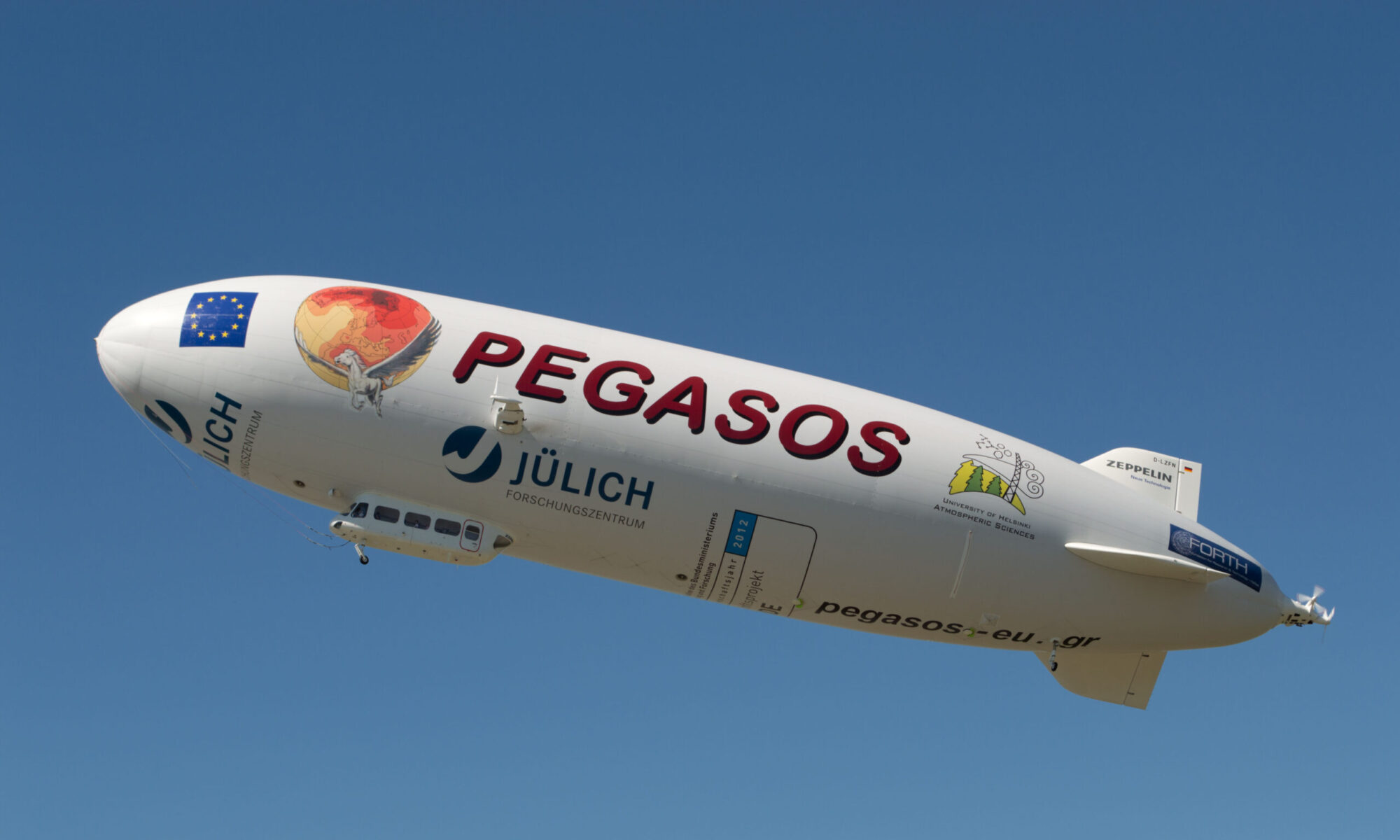
Ballonets keep the internal pressure inside the Zeppelin NT constant, the shape, however, is mainly maintained by a rigid, triangular framework, even in the case of pressure loss. All heavy parts such as the propulsion engines with propellers, control surfaces, gondola etc. are mounted directly to this structure in the best possible place. The engines, for example, are placed well away from the cabin, so that the passengers are not disturbed by noise or vibrations. The positioning of the engines also accounts for the airship´s high maneuverability. Due to the use of state-of-the-art components an excellent payload to dead load ratio is achieved. The framework combined with the envelope carry the loads in operation.

The bending forces which are crucial for the design are almost uniformly absorbed by the rigid structure and the envelope. Air-filled ballonets are positioned underneath the framework and protect the rigid structure from harmful shocks, in case of a very hard landing, by forming an air-cushion.

Technical data

  • Dimensions total volume 8,200 m3
  • Length 75 m
  • Max. diameter 14.16 m
  • Width
  • Height
  • Cruising Altitude
    • Standard 300 m above ground
    • max. 3.000 m MSL
  • Weights
    • Max. take-off weight
      • absolute 8,050 kg
      • relative 400 kg
    • Payload 1,900 kg
  • Nacelle
    • People
      • 1 pilot
      • 1 flight attendant / co-pilot
      • 12 passengers
      • 1 toilet
    • Dimensions
      • Lenght: 10,7 m
      • Volume: 29 m³
  • Performance
    • max. cruising speed 120 km/h
    • standard cruising speed 70 km/h
  • Endurance ~22 hours
  • Range 1,000 km
  • Three Lycoming IO-360 engines with a total of 440 kW (600 hp)

Historical Facts

On 2 July 1900 the time had come – the very first Zeppelin took off

In the bay of Manzell/Friedrichshafen Ferdinand Graf von Zeppelin and his engineer Theodor Kober watched the take-off of the 128 m long LZ 1. On its maiden flight the first Zeppelin reached a height of 400 m and covered a distance of about 6 km.

After about 30 years and many ups and downs the Zeppelin airships established the first intercontinental air traffic. The technology originating from Friedrichshafen laid the basis for modern aviation as it now belongs to everyday life. Back then it certainly was out of the ordinary, it was a very exclusive event to take off from an airship hangar out into the world. For the first time passengers, freight and, in particular mail, could travel over the ocean in one or two days. The flight in a Zeppelin – a real revolution!

The end of an era

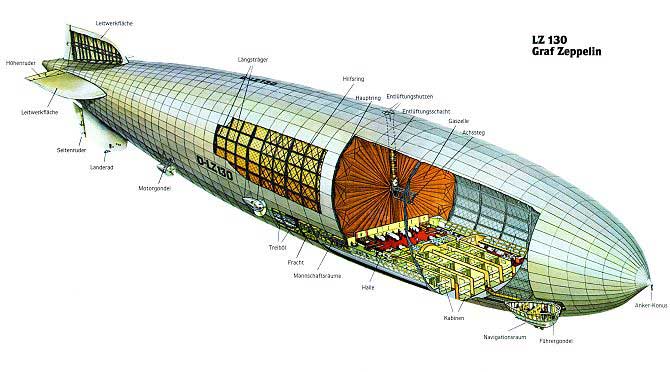
You tend to hear and read that the Zeppelin era came to an end due to the Lakehurst disaster on 7 May 1937. The real reason, though, can be found in the international political development during the years 1936-1940. Because of the aggressive politics of the NS government, the USA initiated an embargo on helium, the only non-inflammable lifting gas for airships. Consequently, there was no helium obtainable in Germany. The LZ 129 HINDENBURG, which was originally designed for the use of helium, had to therefore be converted to the use of inflammable hydrogen. That´s how the disaster happened, no matter which of the many discussed causes were the reason for the fire. The ultimate end – the dismantling of the two airships LZ 127 GRAF ZEPPELIN and LZ 130 GRAF ZEPPELIN II and the blowing up of the airship hangars in Frankfurt – was decreed by the Nazi regime, partly because of being hurt in their pride due to the HINDENBURG disaster, but mainly as the airships were no good for military use and had to make way for the air force.

During the terrible World War II aviation technology was intensively further developed by all nations taking part in the war. After the end of the war civil aviation, of course, profited of the achieved progress. With regard to airships however, there was no further technical development, apart from the non-rigid airships which were constructed in the USA. After the war they developed into advertising blimps which we occasionally see in the sky.

Types of Airships

There are three types of airships. Airships without an internal structure, airships whose shape is determined by a rigid structure and a mixture of both types.

Non-rigid airships (blimps)

1. Nose cone with battens 2. Forward ballonet 3. Gondola suspension 4. Aft ballonet 5. Rudder 6. Gondola 7. Engines 8. Lighting 9. Air vents 10. Air valves 11. Helium Valve Fig. Blimp by Goodyear/USA

This is the oldest and most simple type of construction. The airship´s envelope is filled with lifting gas and is kept at a pressure level in excess of the surrounding air pressure by one or several air filled ballonets. The airship only retains its shape due to the pressure of the lifting gas. The pressure must always be high enough to regulate all kinds of forces occurring during different flight maneuvers, for example air resistance at full speed. The gondola with engines, fuel tanks etc. is attached with suspension cables to the catenary curtain which is fixed to the top of the envelope. Due to the fact that the engines are mounted directly to the gondola, passengers are affected by engine noise and vibration.

This type of airship was specially developed for military purposes during World War II by GOODYEAR/USA and is now mainly used for advertising purposes.

Rigid airships

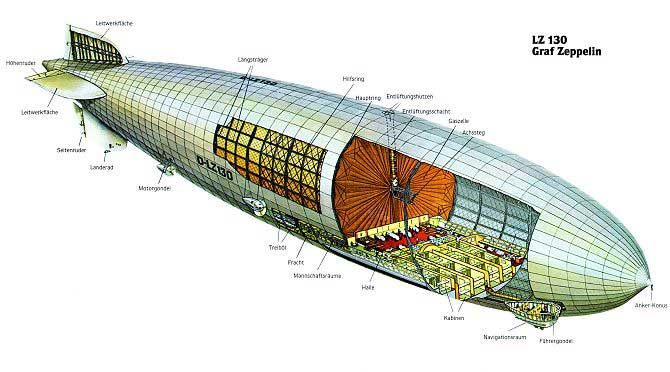
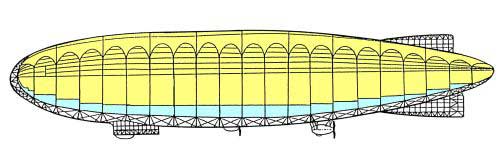
Thanks to Graf von Zeppelin and his followers this type of airship achieved a design which is still admired to this day. Rigid airships retain their shapes by using an internal framework or a rigid outer skin. The lift gas cells lie underneath the framework and are mostly non-bulging. Air pressure fluctuations and different temperatures lead to changes to the filling levels of the gas cells. Rigid airships can be built very large. LZ 129 HINDENBURG and LZ 130 GRAF ZEPPELIN had a volume of 200,000 m3 and length of 245 m.

The benefits of rigid type of airship are:

  • loads can be spread efficiently inside the envelope
  • air stream and solar radiation have no direct effect on lift gas cells
  • a leak in the envelope or a lift gas cell does not lead to loss of gas and consequently to nonmaneuverability

However, this type of airship is very costly and the dead load to payload ratio is comparatively higher than in non-rigid airships.

Semi-rigid airships

In order to combine the benefits of the two types of airships mentioned above, so-called semi-rigid airships were designed. The most popular semi-rigid airships were built by the Italian general and airship pioneer Umberto Nobile, who flew over the north pole in the airship NORGE in 1926. The semi-rigid airship maintains its envelope shape through ballonets and has a fixed keel to which various loads such as engines etc. are mounted.

Fig. Semi-rigid airship ITALIA (System Nobile)

DZR Zeppelin Flights

Fly with us and discover the world with different eyes. Book the fulfillment of a dream. The Deutsche Zeppelin-Reederei’s standard offer includes sightseeing flights from 30 minutes to 2 hours.

Flights from Friedrichshafen

  • „Rheinfall-Schaffhausen“ (120 min),
  • „Bodensee“ (120 min)
  • „Dornbirn“ (90 min)
  • „Allgäu (90 min)
  • „Mainau“ (60 min)
  • „St. Gallen“ (60 min)
  • „Schweizer Ufer“ (60 min)
  • „Bregenz“ (60 min)
  • „Ravensburg“ (45 min)
  • „Meersburg“ (45 min)
  • „Lindau“ (45 min)
  • „Friedrichshafen“ (30 min)

Flights from München

  • „München“ (40 min)

Flights from Bonn/Hangelar

  • „Kölner Dom“ (60 min)
  • „Bonn-Siebengebirge“ (45 min)

Flights from Mönchengladbach

  • „Mönchengladbach“ (45 min)
  • „Düsseldorf“ (45 min)

NEW 2023 Flights from Mühlheim

  • „Essen/Mühlheim und Umgebung“ (45 min)

Flights from Frankfurt

  • „Frankfurt“ (45 min)

Die Flugbuchung erfolgt direkt bei der Deutschen Zeppelin-Reederei.

Deutsche Zeppelin Reederei GmbH
Messestr. 132, 88046 Friedrichshafen
Tel. +49 7541 5900-0

www.zeppelinflug.de (Online-Buchung)

Farewell to Wolfgang von Zeppelin

On April 22, 2024, our Honorary Chairman Dipl.-Ing. (FH) Senator E.h. Wolfgang von Zeppelin passed away at the age of 88. At this year’s General Meeting on May 11, 2024, we will commemorate our founding Chairman and remember him and his achievements.

Calender 2024

We are once again planning our club calendar with motifs of the Zeppelin NT for 2024. Do you have a particularly beautiful photo of your flight? Then send it to us in printable resolution (at least 3,000 x 2,000 pixels) to info@zeppelin-tourismus.de by August 31, 2023. Once again, we will be giving away a one-hour flight on the Zeppelin NT among all those who submit photos.